Home

Doctoral researcher

Julius Störk

ORCID ↗

for . I develop machine-learning methods that connect , , and . At VARTA and TU Braunschweig, my work spans , , and for changing materials and operating conditions. I work on this because reliable ML for battery manufacturing directly accelerates the transition to sustainable energy.

Industrial PhDVARTA Microbattery GmbHTU Braunschweig

Email me ↗

Open to collaborations on continual learning for process modelling and data-efficient ML in battery manufacturing.

Portrait of Julius Störk

Publications

all entries (.bib)

Drafts, code, and reproducible results.

Interference and retention in continual learning

Learning a new task can overwrite a model's earlier knowledge. I model this forgetting as weight-interference energy under a task's feature covariance and derive a replay-free controller (IGFA) that protects earlier tasks while sharing capacity where directions do not conflict.

Bar chart. Forgetting on a 410-million-parameter model, indexed to the naive fine-tuning baseline at 100. With the IGFA gate the index falls to 64, a 36 percent reduction. Naive fine-tuning 100 With IGFA gate 64 (−36%)
Forgetting on a 410M-parameter model, indexed to the naive fine-tuning baseline (= 100). The replay-free IGFA gate removes 36% of forgetting.
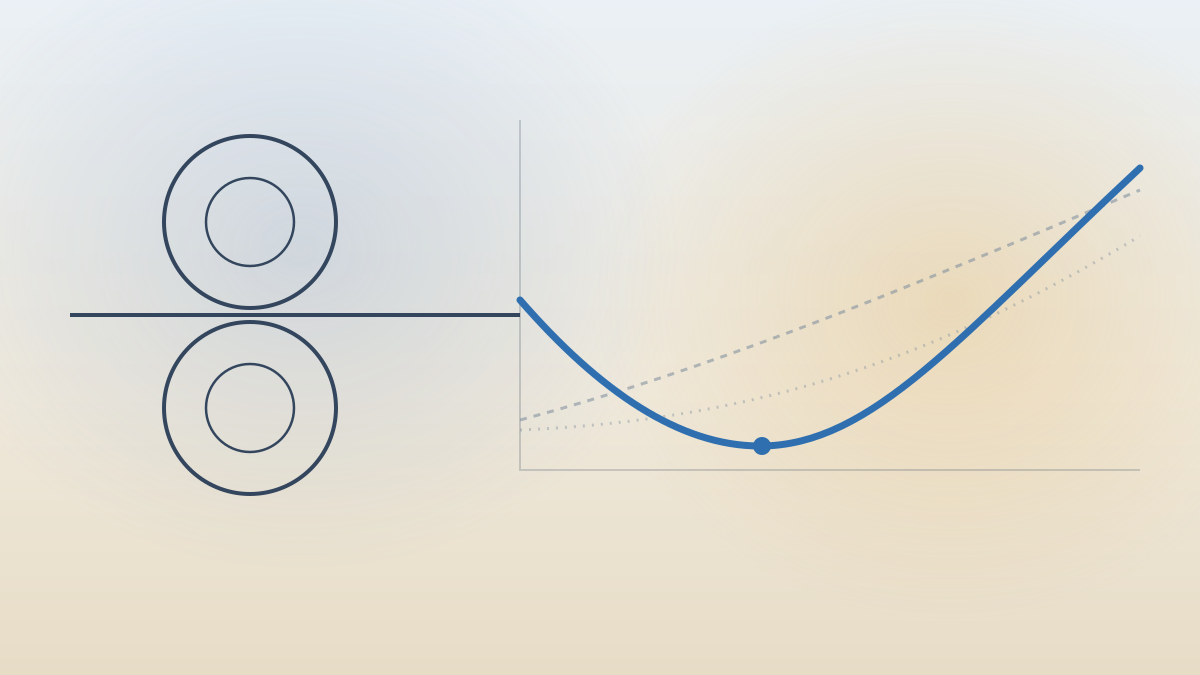
Capturing the calendering U-shape in lithium-ion electrode thermal conductivity

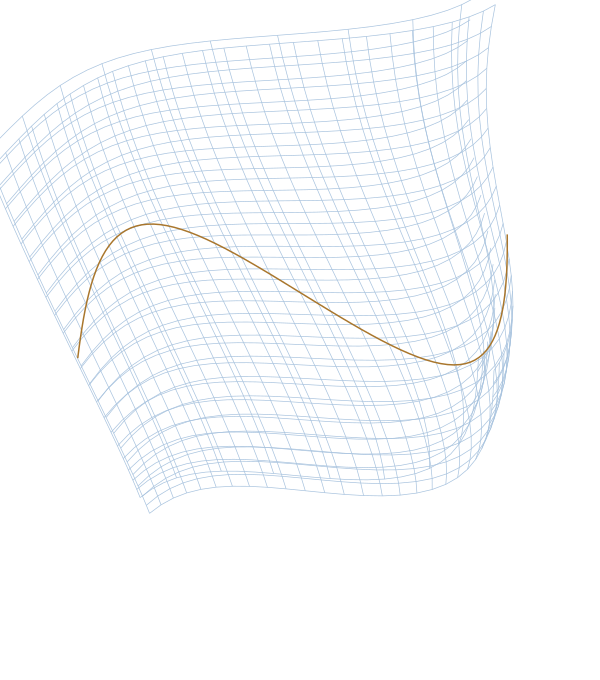
Porosity-only and static-contact models miss the conductivity dip during calendering. I develop a differentiable Zehner–Bauer–Schlünder closure that captures this dip and tests whether contact-network growth or particle reorientation dominates through-plane thermal transport.

Line chart of through-plane thermal conductivity versus compaction for three closure families. Porosity-only and static-contact closures rise monotonically; the calendering-aware ZBS closure first dips to a minimum near 18 percent compaction, then rises. 0% 20% 40% 60% Compaction Π 0.5 1.0 1.5 2.0 λeff (W/mK) Porosity-only Static contact Calendering-aware ZBS
Schematic closures: only calendering-aware ZBS captures the dip then rise. Across 27 fitted states, MAPE falls from 31.1% to 4.5%.

From research code to autonomous agents.

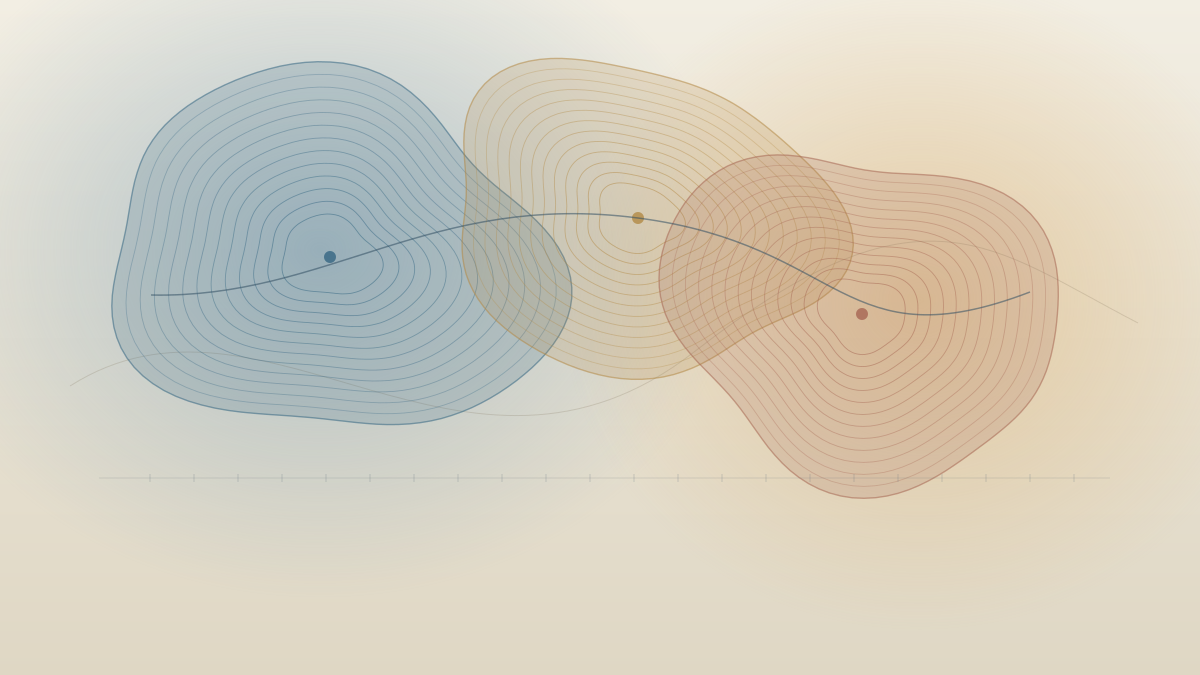
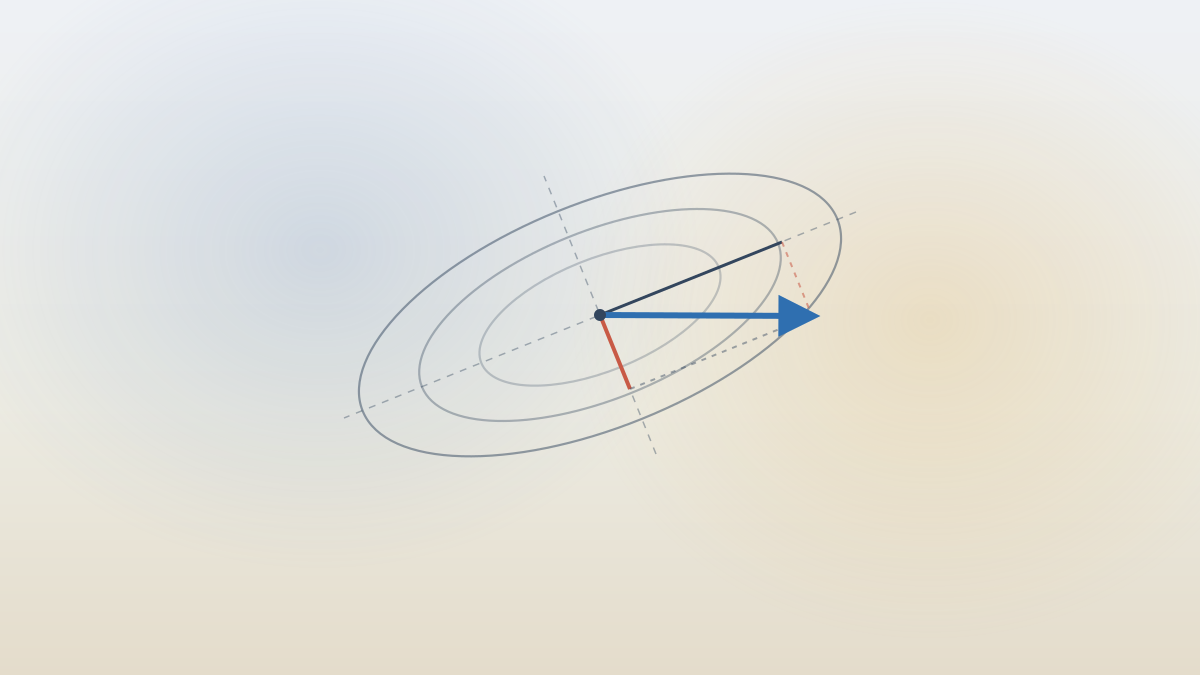
Task covariance contours and an update split into protected and free directionsTask geometry · paper & code ↗
geometry-of-forgetting

Diagnosing forgetting requires tracing how updates interfere with earlier tasks. My research code provides interference-attribution analysis and Colab pipelines for continual pretraining and LoRA fine-tuning, with the working notes and negative results that shaped the paper.

Pythonpaper code
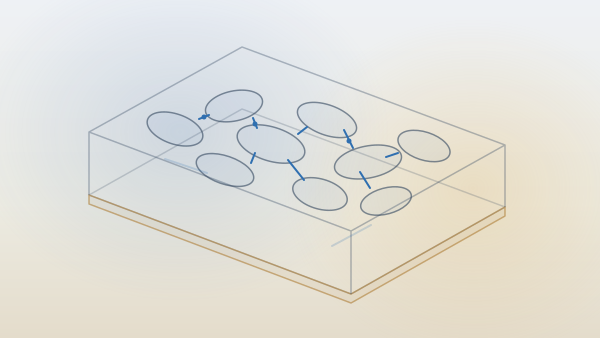
Electrode particles and the calendering-dependent thermal responseProcess → property · paper & code ↗
zehner-electrode-thermal

Predicting electrode thermal conductivity requires accounting for structural changes during calendering. My notebooks calibrate and validate the closure against electrode data and compare it with ML, PINN, and multiphysics approaches.

Jupyterpaper code
FLUIDSCANSAMPLE
Instrument control · scanning droplet cell
HELAO

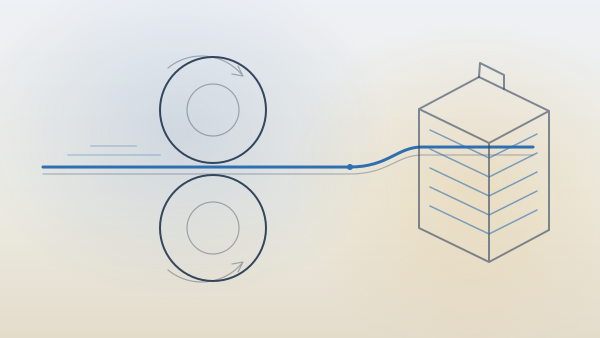
Manual electrochemical screening limits throughput and repeatability. I developed pump and robot control for a scanning droplet cell during my M.Sc. to automate measurement sequences.

Pythonlab automation
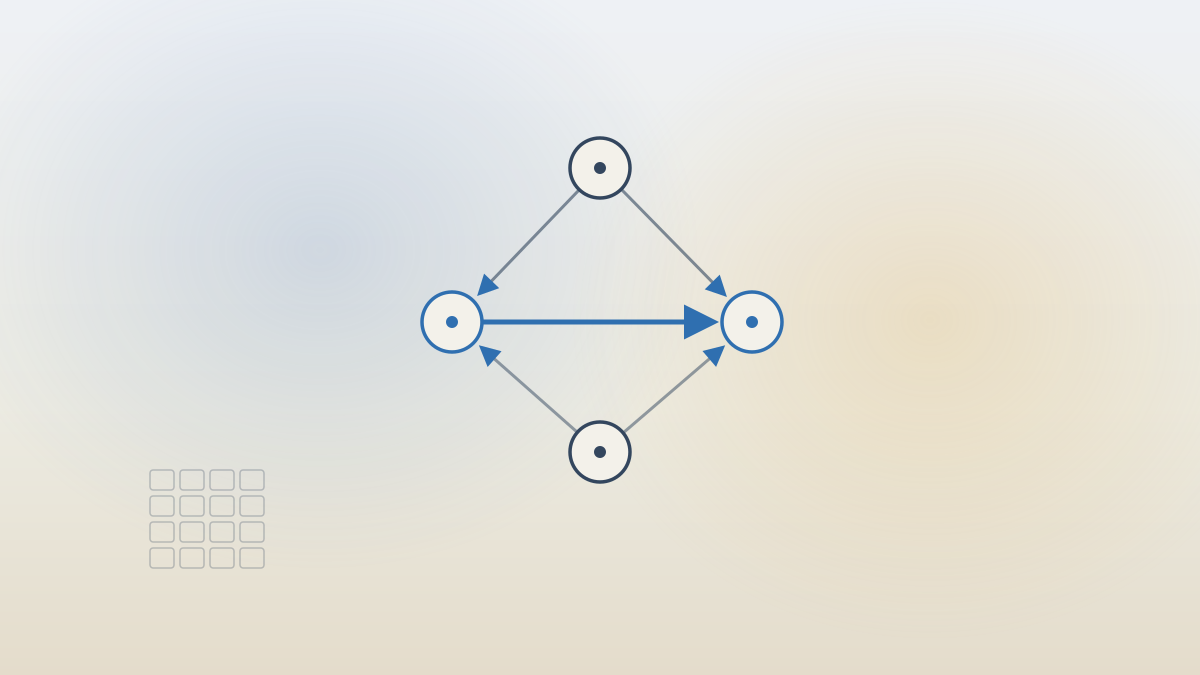
ObserveActEvaluateILLUSTRATIVE AGENT LOOP
Agent experiments · observation to action
arc-autoresearch

Game-playing agents need to infer unfamiliar rules from observations and feedback. My ARC-AGI-3 experiments combine a Python agent with per-game diagnostics and analysis notebooks to investigate where its decisions succeed or fail.

Pythonagents

Blog

all posts

Pick a rabbit hole.

Latest / Fresh from the notebook

13 September 2026 · Reading notesReading ConvMem: Long-Context Reasoning as a Summary TreeConvMem reads a long document as a tree of question-conditioned summaries instead of a chain of memory updates, which cuts the path from a fact to the answer from linear to logarithmic. Notes on the method, results and cost, and seven ideas for a path shorter than logarithmic.Read the notes ↗ 23 August 2026 · Continual learningFinding a Fair Evaluation Under Changing RepresentationsCertified retention is easy for frozen features and collapses once the representation moves. A bottom-up stripe benchmark that makes adaptation provably necessary, and CARG, the metric for the accuracy you lose when the retention certificate has to hold.Read the notes ↗

Selected experience

full CV

From cathode chemistry and fuel-cell production to electrode manufacturing and continual learning.

Industrial doctorate

Electrode Engineer

VARTA Microbattery · TU Braunschweig

I develop and qualify coating, calendering, and semi-dry processing routes for lithium-ion electrodes.

3 kg h−1Semi-dry processing across chemistries
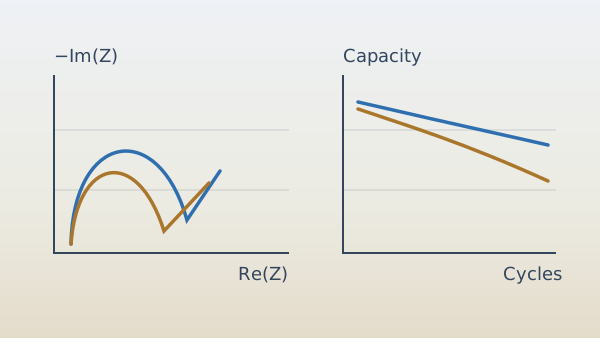
6.9×Lower model error across 27 calendering states
36%Retention improvement on a 410M-parameter model
Research internship

MOF catalysis

Technical University of Munich

I synthesised and screened catalyst pairs for sequential epoxidation and CO₂ fixation within one framework.

99%Conversion of PO to propylene carbonate
2×Yield improvement via metalation
SequentialEpoxidation and CO₂ fixation in one framework
Process development

Solid oxide fuel cells

Robert Bosch GmbH

I scaled ceramic paste processing from laboratory batches toward mass-production volumes.

0.5 → 50 L/hScaled ceramic paste from lab to MP
ReformulatedAdapted paste chemistry for scale
Screen-printEnsured downstream processability
Research assistant

Cathode active materials

Max Planck Institute · BASF

I established precursor routes for NCA and NMC and investigated lower-temperature lithiation strategies.

Precursor screenSystematically screened NCA & NMC calcination routes
30%Lower calcination temperature
In-situ XRDValidated phase formation during synthesis

Contributions

terminal-bench-science
Terminal-Bench Science · task contribution (PR #1511)

I contributed a task to terminal-bench-science, a science-focused task set built on Terminal-Bench, the benchmark for evaluating AI agents on hard, realistic command-line tasks (arXiv:2601.11868).

benchmarkagents

Contact

For industry

Does your process model struggle when materials or settings change? I’d be interested in exploring what your process logs and electrode measurements can tell us, and how to evaluate models under those changes.

For researchers

Working on continual learning or physics-informed electrode models? I’d welcome a joint study, a shared dataset, or a comparison that tests where our methods break.

I’d be happy to collaborate, share data, or discuss experimental results. If you’re interested, feel free to email me with a short description of your setup and what you’re trying to achieve.

Leave me a message .