Home

Doctoral researcher

Julius Störk

Artificial intelligence for battery manufacturing. I develop machine-learning methods that connect process data, physical models, and electrochemical performance. At VARTA and TU Braunschweig, my work spans hands-on electrode development, continual learning, and process–property modelling for changing materials and operating conditions.

Industrial PhDVARTA Microbattery GmbHTU Braunschweig

Portrait of Julius Störk

Selected experience

Full CV →
Industrial doctorate

Electrode Engineer

VARTA Microbattery · TU Braunschweig

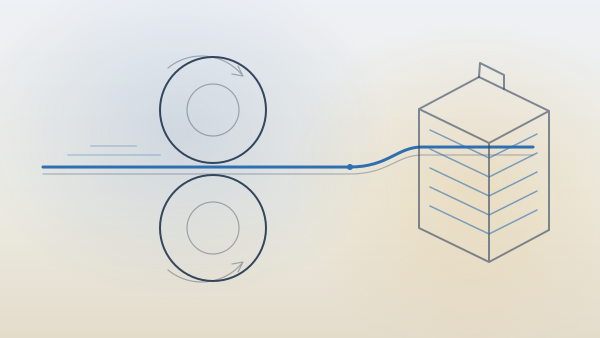
Developing and qualifying coating, calendering, and semi-dry processing routes for lithium-ion button cells.

3 kg h−1Semi-dry processing across multiple chemistries
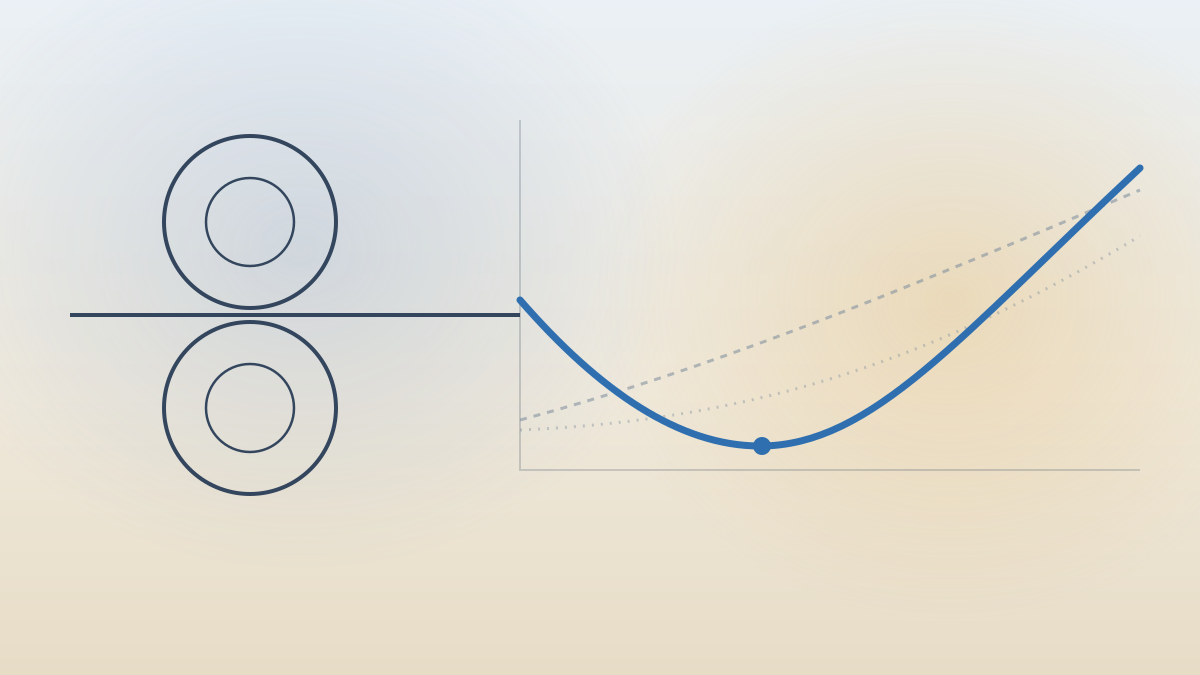
6.9×Lower model error across 27 calendering states
−36%Forgetting on a 410M-parameter model
Research internship

MOF catalysis

Technical University of Munich

Synthesised and screened catalyst pairs for sequential epoxidation and CO₂ fixation within one framework.

Process development

Solid oxide fuel cells

Robert Bosch GmbH

Scaled ceramic paste processing from laboratory batches toward mass-production volumes.

Research assistant

Cathode active materials

Max Planck Institute · BASF

Established precursor routes for NCA and NMC and investigated lower-temperature lithiation strategies.

Research

Current questions
01Retention

How can models learn a changing process without forgetting?

Continual learning, geometric interference, low-rank task structure, and robust adaptation under process drift.

02Structure

Which manufacturing variables actually determine electrode properties?

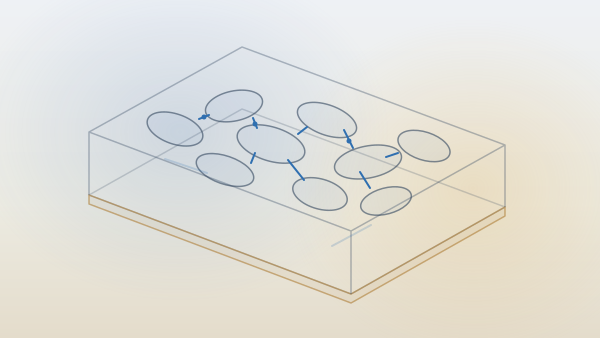
Dry processing, extrusion, coating, calendering, and physics-aware process–structure–property models.

03Performance

How does process history surface in electrochemical behaviour?

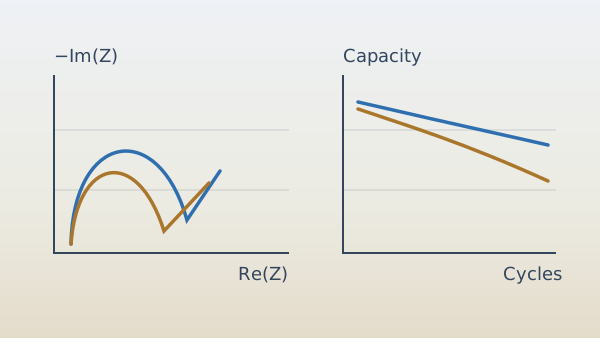
Impedance spectroscopy, cycling-data interpretation, and linking process conditions to cell performance.

Publications

All entries (.bib) ↓
Interference and retention in continual learning Preprint
Julius Störk · VARTA Microbattery GmbH; Institute for Particle Technology (iPAT), TU Braunschweig · 2026

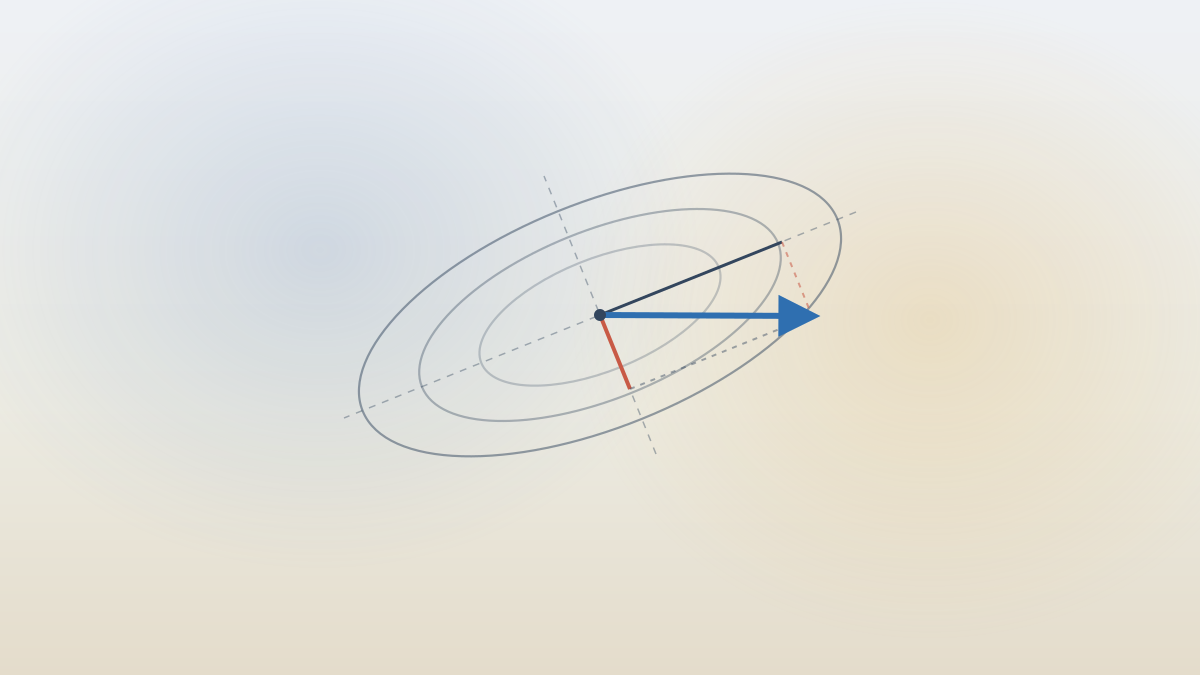
Models forgetting as weight-interference energy under a task's feature covariance, and derives a replay-free structural controller (IGFA) that protects earlier tasks while allowing capacity to be shared where directions do not conflict.

Bar chart. Forgetting on a 410-million-parameter model, indexed to the naive fine-tuning baseline at 100. With the IGFA gate the index falls to 64, a 36 percent reduction. Naive fine-tuning 100 With IGFA gate 64 (−36%)
Forgetting on a 410M-parameter model, indexed to the naive fine-tuning baseline (= 100). The replay-free IGFA gate removes 36% of forgetting.
cs.LG cs.AI
Cite (BibTeX)
@misc{stoerk2026interference,
  title         = {Interference and Retention in Continual Learning},
  author        = {St{\"o}rk, Julius},
  year          = {2026},
  eprint        = {2607.09202},
  archivePrefix = {arXiv},
  primaryClass  = {cs.LG},
  doi           = {10.48550/arXiv.2607.09202},
  url           = {https://arxiv.org/abs/2607.09202}
}
Capturing the calendering U-shape in lithium-ion electrode thermal conductivity Preprint
Julius Störk · VARTA Microbattery GmbH; Institute for Particle Technology (iPAT), TU Braunschweig · 2026

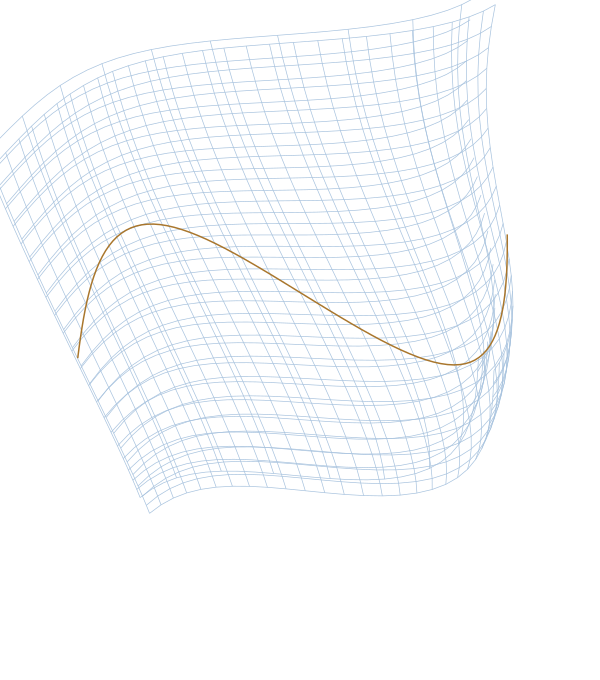
A differentiable, calendering-aware Zehner–Bauer–Schlünder closure that tests whether contact-network growth or particle reorientation dominates through-plane thermal transport.

Line chart of through-plane thermal conductivity versus compaction for three closure families. Porosity-only and static-contact closures rise monotonically; the calendering-aware ZBS closure first dips to a minimum near 18 percent compaction, then rises. 0% 20% 40% 60% Compaction Π 0.5 1.0 1.5 2.0 λ_eff (W/mK) Porosity-only Static contact Calendering-aware ZBS
Schematic closure comparison (functional forms from the companion note, not fitted data). Porosity-only and static-contact closures are monotone by construction; only the calendering-aware ZBS closure reproduces the measured dip-then-rise. Fitted across 27 calendering states, MAPE falls from 31.1% to 4.5%.
cond-mat.mtrl-sci physics.chem-ph
Cite (BibTeX)
@misc{stoerk2026calendering,
  title         = {Capturing the Calendering U-Shape in Lithium-Ion
                   Electrode Thermal Conductivity},
  author        = {St{\"o}rk, Julius},
  year          = {2026},
  eprint        = {2607.11521},
  archivePrefix = {arXiv},
  primaryClass  = {cond-mat.mtrl-sci},
  doi           = {10.48550/arXiv.2607.11521},
  url           = {https://arxiv.org/abs/2607.11521}
}
Reading notes

Reading CausalPFN: causal effects as in-context prediction

A NeurIPS 2025 paper trains one transformer on simulated, identifiable causal worlds; new observational data goes in as context, treatment-effect posteriors come out. What holds it up, and where it breaks.

geometry-of-forgetting

Research code behind the continual-learning preprint: interference-attribution analysis and Colab pipelines for continual pretraining and LoRA fine-tuning of language models, plus the working notes and negative results that shaped the paper.

Pythonpaper code
zehner-electrode-thermal

Notebooks behind the calendering closure: calibration and validation against the electrode data, alongside ML, PINN, and multiphysics comparisons on the same problem.

Jupyterpaper code
HELAO

Instrument control from my M.Sc. work on automated high-throughput electrochemistry: pump and robot control for a scanning droplet cell.

Pythonlab automation
arc-autoresearch

Agent experiments for ARC-AGI-3: a Python game-playing agent with per-game diagnostic scripts and analysis notebooks.

Pythonagents

Contact

Happy to hear about collaborations, data, or awkward results that do not fit the model.